
A breakdown is stressful enough on its own. But when it happens on a busy road — the Princes Highway, the M1, or any major route through the Illawarra — it becomes a genuine safety situation.
Every year, people are seriously injured or killed in secondary accidents after a breakdown. In most cases, the outcome could have been very different with a few simple steps taken immediately. Here’s what to do.
The First 30 Seconds Matter Most
The moment you realise your vehicle is in trouble — engine cutting out, tyre gone, steam from the bonnet — your first priority is getting safely off the road. Not calling for help. Not checking what’s wrong. Getting off the road.
Steer toward the shoulder, left lane, or an exit — whatever gets you away from fast-moving traffic as quickly as possible. Keep steering even if the engine is off — you’ll still have some control, though it may feel heavy.
If you can reach a service station, car park, or side street, do it. Even if it means running on a flat tyre for a short distance — destroying a tyre is far better than stopping in a live traffic lane.
Once Stopped: The Safety Sequence
1. Turn On Hazard Lights Immediately
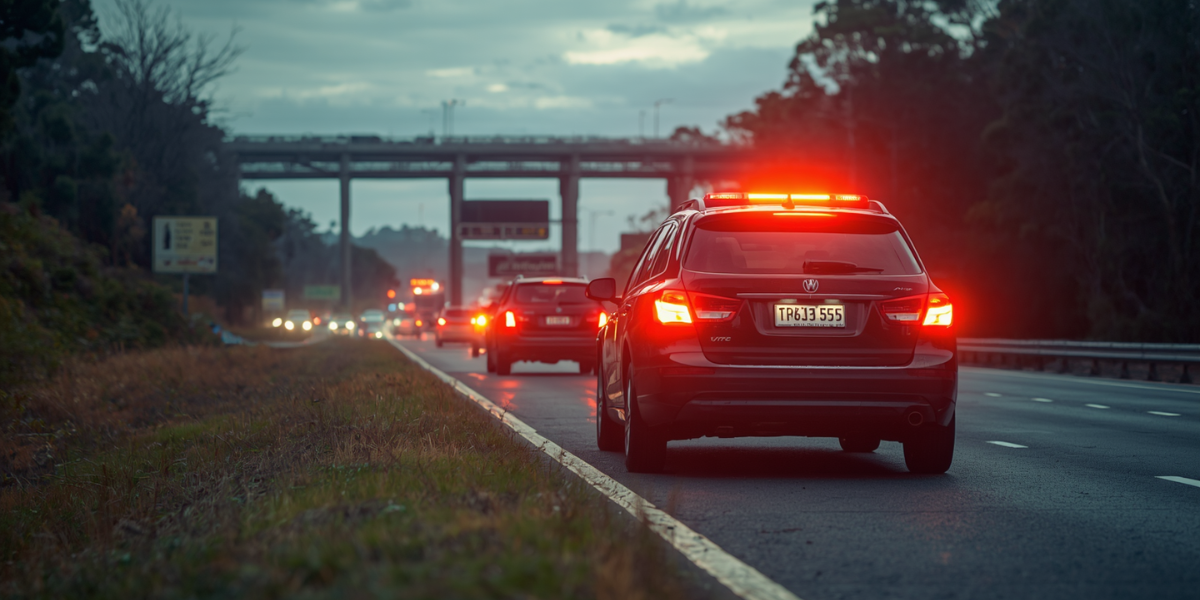
The moment you stop, hazard lights on. This is non-negotiable — it signals to every approaching driver that something is wrong. Do this before you open the door, before you look at the engine, before anything else.
On the Princes Highway or M1 Motorway near Wollongong, vehicles can approach at 80–110km/h. At those speeds, a car emerging from the blind spot without hazard lights is genuinely life-threatening to the driver standing beside it.
2. Get Everyone Out of the Vehicle — on the Correct Side
If you’ve stopped on the shoulder of a road, get all passengers out of the vehicle. But exit on the left (kerb) side only — away from traffic. A passenger-side door opened into a live lane is extremely dangerous.
Once out, move as far from the road as practical. A grassy embankment, behind a barrier, up a slope — anywhere away from the travel lanes. Do not stand behind or beside the vehicle in a lane position.
3. Place Warning Triangles if You Have Them
If you carry reflective warning triangles in your vehicle, place one approximately 30–50 metres behind your car on the same side as the shoulder. This gives approaching drivers advance warning before they reach your vehicle.
In low-light or nighttime conditions, these are especially valuable. If you don’t have triangles, consider adding them to your boot kit — they’re inexpensive and worth keeping.
4. Keep Your Seatbelt On if You Stay in the Vehicle
In some situations — a motorway with no safe shoulder space, heavy rain, or an unsafe roadside environment — staying inside the vehicle with your seatbelt on is actually safer than standing outside. If you do stay inside, make sure hazard lights are on and stay well clear of the door.
Calling for Help: What to Tell the Operator
When you call 000 (if there are injuries or immediate danger) or a towing service like Express Towing (for a standard breakdown), have this information ready:
- Exact location — road name, direction of travel, and the nearest landmark or kilometre marker. “On the Princes Highway near the Fairy Meadow exit, northbound” is far more useful than “on the highway somewhere near Wollongong.”
- Vehicle description — make, model, and colour
- Your mobile number — so the operator can call back if they lose you
- Nature of the problem — flat tyre, engine failure, accident damage
- Whether anyone is injured
The more specific your location, the faster the response. On the Princes Highway, look for green kilometre markers on the roadside — these give emergency services precise location information.
Nighttime Breakdowns
A nighttime breakdown on any Illawarra road raises the risk significantly. A few additional steps:
- Interior light on if you’re inside the vehicle — makes the car more visible
- Stay visible but not in the traffic lane — reflective clothing, torch from your phone, or a hi-vis vest if you have one
- Don’t stand at the back of the vehicle — if a driver fails to see you and hits the car, the rear end is the most dangerous place to be
- Lock your doors if you’re waiting inside, particularly at night
What to Keep in Your Car for Breakdowns
A simple emergency kit in your boot costs very little and can make a significant difference:
- Reflective warning triangles (at least one, ideally two)
- High-visibility vest — visible from oncoming traffic if you need to stand roadside
- Torch with good batteries
- Fully charged phone or portable phone charger
- Water — important if you’re waiting a long time in summer heat
- Express Towing’s number saved in your phone — so you’re not searching in a stressful moment
Breakdown Hotspots in the Illawarra
Some locations in the Wollongong area are more difficult breakdown spots than others:
Bulli Pass — the descent and climb on the Lawrence Harcourt Drive can be tough on cooling systems and brakes, particularly in summer. Overheating is common on this stretch.
Princes Highway through Fairy Meadow and Thirroul — heavy traffic, limited shoulder space, and pedestrian areas make a breakdown here particularly hazardous.
M1 / Princes Motorway — higher speeds and less shoulder depth in some sections. Get as far left as possible and stay in the vehicle if it’s unsafe to exit.
Stanwell Park to Clifton — the coastal road in this area has limited shoulder space and steep terrain. If you break down here, stay in the vehicle and call for help.
When to Call 000 vs When to Call a Tow Truck
Call 000 when:
- Anyone is injured
- There’s a fire, fuel leak, or smoke from the vehicle
- You’re in immediate danger from traffic
- A driver involved in a collision leaves the scene
Call a tow truck like [Express Towing](https://expresstowing.com.au/) when:
- The vehicle has broken down but no one is hurt
- You’ve been in a minor accident and the car can’t be driven
- You need the vehicle transported to a repairer
If you’re unsure, call 000 first. The operator will direct you appropriately.
Stuck on the Road in the Illawarra?
Express Towing provides emergency towing and roadside assistance across Wollongong, Fairy Meadow, and the broader Illawarra region — 24 hours a day. We know these roads, we respond fast, and we’ll get you and your vehicle sorted safely.